This is not a formal chronology. It is a journey through what happened in this land, arranged from old to new. Legend and documented history overlap, and sometimes it is impossible to separate them. That uncertainty is also part of Hōki’s memory.
Long ago — the age of ogres
Date unknown; legend
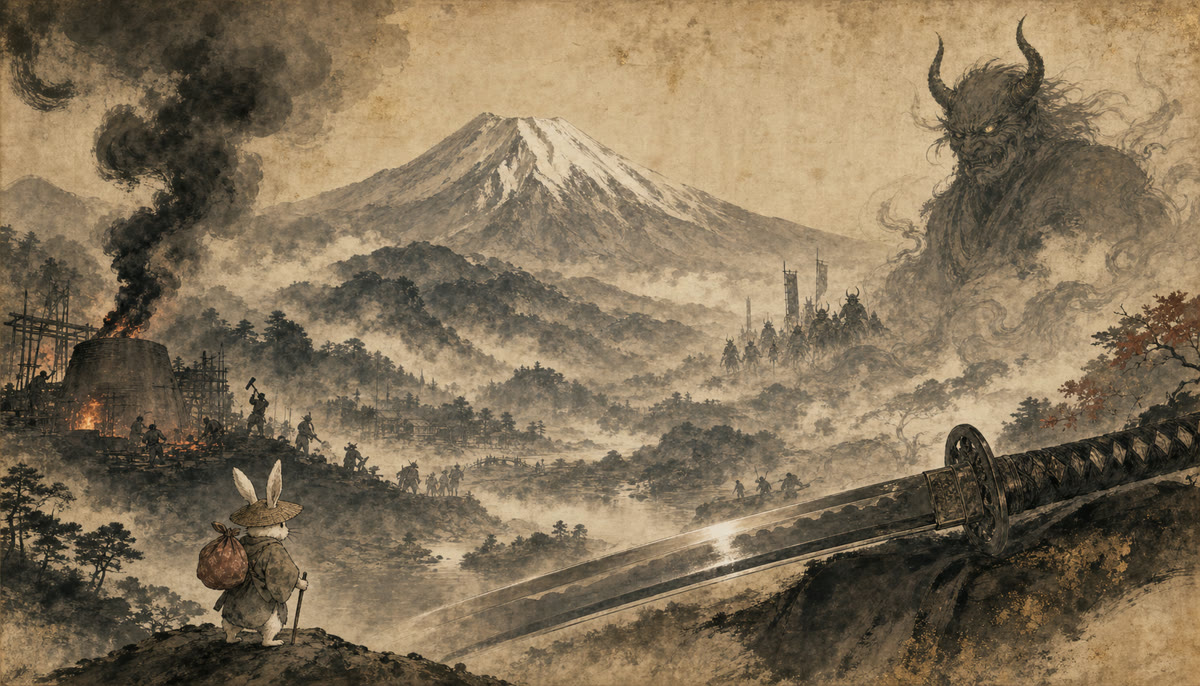
Hōki’s oldest story says that Emperor Kōrei, the seventh emperor named in Japan’s early chronicles, defeated ogres here. His historicity is unresolved, but the tale became the foundation of Hōki’s ogre tradition and has even been proposed as an ancestor of the Momotarō story.
The stage is Mt. Kizumiyama, 326 metres high. Three Sasafuku shrines in Hino District worship Emperor Kōrei. Tradition says he was enshrined as Sasafuku Ōkami in 709, which means the story has been carried here for at least thirteen centuries.
One interpretation sees the “ogres” as ironworkers whose extraction of iron sand disturbed rivers and caused floods. From the beginning, iron and ogres are entwined.
The 670s — a major temple
In the late seventh century, a substantial temple stood at Ōtono in present-day Hōki Town. Only the ruins survive, but excavations uncovered a stone shibi, an ornamental roof-end tile now designated an Important Cultural Property. Stone examples are exceptionally rare in Japan.
The temple shows that Hōki was connected with the culture of the capital at an early date. It was not an isolated backwater.
The 980s–990s — Yasutsuna forged swords
Around the Eien era, the historical smith Yasutsuna worked in Hōki Province. He is often called a founder of the Japanese sword tradition and is counted with Sanjō Munechika and Tomonari among Japan’s earliest master smiths.
His most famous blade is Dōjigiri Yasutsuna, now a National Treasure in the Tokyo National Museum and traditionally ranked first among the Five Swords Under Heaven. About thirty signed works survive. Another blade, Tenkōmaru at Tsuboi Hachimangū in Osaka, is said to have been forged from the same iron.
Five possible forge sites remain under discussion. Ōhara in Hōki Town is a strong tradition, while a forge excavated at Kusaka in Yonago in 1987 provides the clearest archaeological evidence.
Read more: Yasutsuna and Hōki’s tatara ironmaking / The Iron of 1,030 Years Ago Is Still Here
Around 990 — the defeat of Shuten Dōji
Tradition; dated variously to 990, 995, or 1018
Legend says Minamoto no Raikō and his Four Guardians defeated Shuten Dōji on Mt. Ōe and cut off his head with Yasutsuna’s tachi. This is the source of the name Dōjigiri.
The conquest is legendary, but Yasutsuna’s sword and the name attached to it are real. Hōki’s much older Emperor Kōrei story belongs to another tradition, yet the sword connects the two worlds of ogres.
Read more: When Did the Name Dōjigiri Begin?
The eleventh and twelfth centuries — the Ko-Hōki smiths
Yasutsuna was not alone. At least twelve smiths, including his son Sanemori and his follower Yasuie, are associated with the independent Ko-Hōki tradition. A tachi by Yasuie is also a National Treasure in the Kyoto National Museum.
Masamune’s later Sōshū tradition is said to have learned from Ko-Hōki workmanship. The school faded around the end of the Heian period, perhaps because of dwindling resources, competition from Bizen, and distance from Kyoto. Swordmaking in Hōki nevertheless continued through Kunimune and the Hiroga family.
1162 — a temple at Nibu
Gotō Sanemoto built Dentōji Temple at Nibu. It burned repeatedly and was rebuilt each time; the present main hall dates to 1737. Nibu later developed into a post town on the Izumo Kaidō.
1221 — an emperor on the road to exile
After the Jōkyū Disturbance, retired Emperor Go-Toba was exiled to the Oki Islands. His route followed the Izumo Kaidō through Mizokuchi and Nibu. Another emperor would later pass through the same region in the opposite direction.
1333 — the day Hōki changed Japanese history
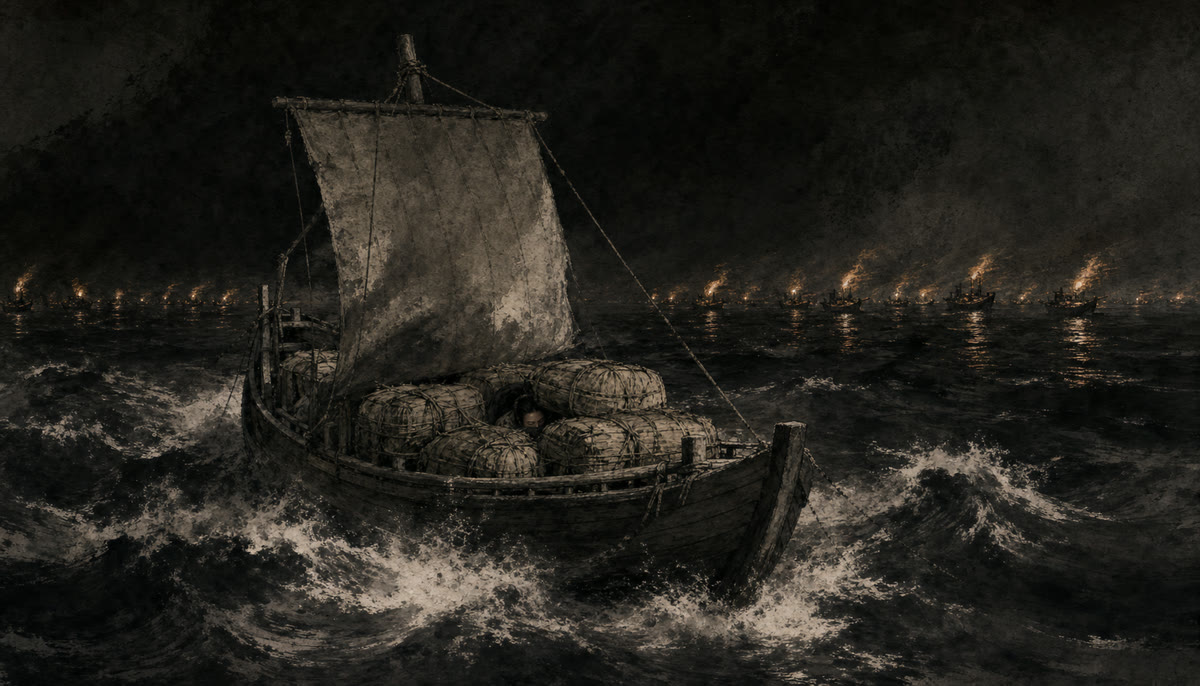
Emperor Go-Daigo escaped exile on Oki with only Chigusa Tadaaki beside him. The Taiheiki says he hid in barrels of dried fish aboard a merchant vessel and prayed with a Buddhist relic when more than a hundred pursuing boats approached. The rival Baishōron preserves a different account involving camouflage with squid.
He landed at Nawa Harbour, present-day Mikuriya in Daisen Town.
Nawa Nagatoshi and the Battle of Mt. Senjō
Nawa Nagatoshi was a wealthy maritime trader and local warrior. His brother Nagashige rallied just over twenty relatives, carried the emperor up Mt. Senjō, and prepared to resist.
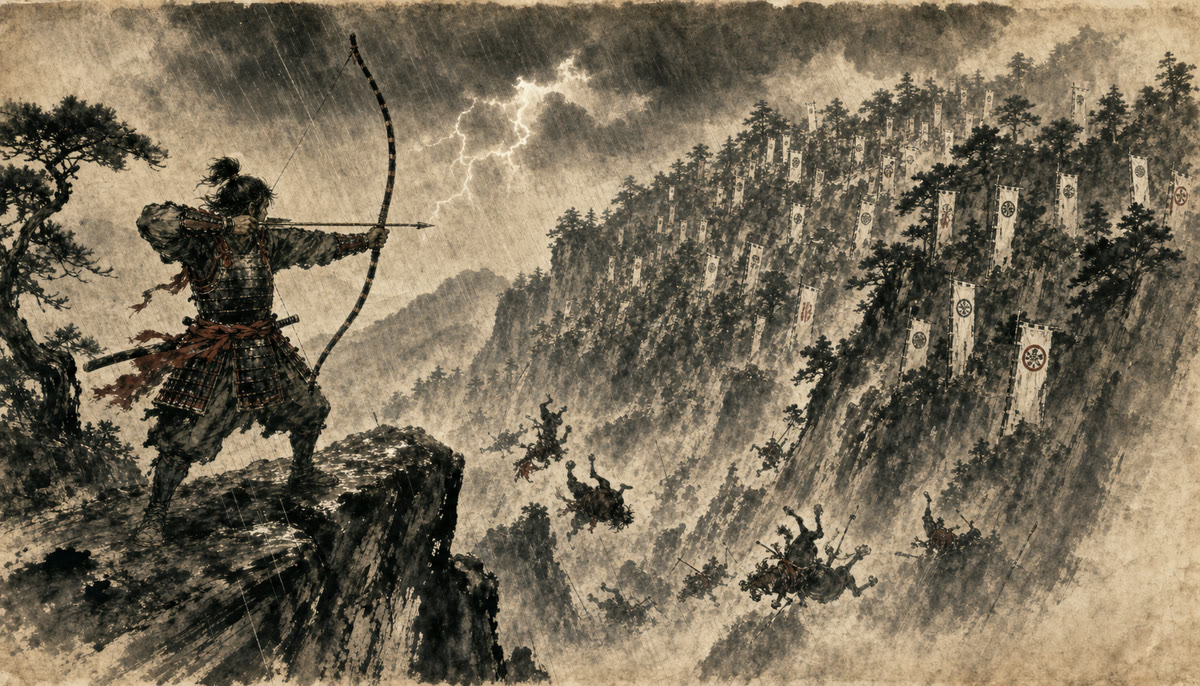
The odds were roughly 150 horsemen against 3,000. Nagatoshi painted local family crests on hundreds of lengths of white cloth and tied them among the trees to create the appearance of a great army. Under cover of a storm, his force attacked at night and drove many enemies over the cliffs.
After the victory, Go-Daigo remained on Mt. Senjō for about eighty days and issued orders to overthrow Hōjō Takatoki. Ashikaga Takauji changed sides, the Rokuhara government fell, and Nitta Yoshisada attacked Kamakura. The Kamakura shogunate collapsed in only fifteen days.
Mt. Senjō in Hōki had become a turning point in Japanese history.
Nagatoshi later became one of Go-Daigo’s four most trusted commanders, known collectively as the Sangi Issō. He died in battle in Kyoto in 1336. His descendants moved to Kyushu and became lords of Uto Castle.
The 1370s — the Taiheiki
About forty years after the battle, the forty-volume war chronicle Taiheiki took shape. Its seventh volume gives a central place to Mt. Senjō and Nawa Nagatoshi, writing Hōki into Japanese literary history. The Northern Court account Baishōron preserves a different perspective on the same age.
1565 — a shogun died wearing Dōjigiri
Ashikaga Yoshiteru, the thirteenth shogun, was remembered as the “Swordmaster Shogun.” When forces of the Miyoshi and Matsunaga attacked his residence, tradition says he planted famous swords around him and fought by changing blades as each was damaged. One was Dōjigiri Yasutsuna. After Yoshiteru’s death, the sword passed through the fifteenth shogun Yoshiaki to Toyotomi Hideyoshi.
1638 — the Izumo Kaidō as an official route
When Matsudaira Naomasa became lord of Matsue Domain, the Ashiwa residence at Nibu-shuku was designated an official lodging for alternate attendance. The road became a route for daimyō processions, iron transport, and pilgrimage to Izumo Taisha. Izumo no Okuni and Lafcadio Hearn would also travel it.
1719 — Dōjigiri enters the official register
On the orders of the eighth shogun, Tokugawa Yoshimune, Hon’ami Kōchū compiled a register of celebrated swords, the Kyōhō Meibutsuchō. Dōjigiri was recorded as one of these meibutsu.
1779–1921 — an age of iron
The Kondō family of Neu in Hino operated tatara furnaces for 143 years, at their peak running eleven sites at once. Their iron supplied military arsenals and the Yokosuka shipyard. Hōki’s iron and cotton accounted for a large share of Tottori Domain’s outside revenue.
From Yasutsuna’s tenth-century work to the closure of the Kondō operations in 1921, this land produced iron for roughly 940 years.
1951 — Dōjigiri becomes a National Treasure
Dōjigiri was designated a National Treasure under the Law for the Protection of Cultural Properties. In 1962 the state purchased it for ¥26.3 million and placed it in the Tokyo National Museum, following sword expert Honma Kunzan’s recommendation that the blade be preserved nationally.
2025 — the sword arrives through a screen
In August 2025, Dōjigiri Yasutsuna joined the online game Tōken Ranbu as character number “000,” the leading position.
Visitors soon began travelling to Hōki in search of the place where Yasutsuna forged his swords. A blade made a thousand years ago now brings people here through a modern game.
A note from the travelling rabbit: Someone learns about a thousand-year-old sword in a game and comes here. The story of iron, ogres, and swords is still continuing.
The span of this story
| Point | Date |
|---|---|
| Oldest story | Emperor Kōrei’s ogre conquest; undated, but worshipped by 709 |
| Oldest surviving object | Ōdera Temple’s stone shibi, late seventh century |
| Yasutsuna’s age | 980s–990s |
| The Taiheiki age | Battle of Mt. Senjō, 1333 |
| Newest development | Tōken Ranbu pilgrimage, from 2025 |
From legend to object, object to record, and record to contemporary culture, Hōki’s history is threaded with iron, ogres, and swords.
Emperors in this story
| Emperor | Period | Connection with Hōki |
|---|---|---|
| Emperor Kōrei, seventh emperor | Legendary age; historicity unresolved | Hero of the ogre-conquest legend and deity of Sasafuku Shrine |
| Retired Emperor Go-Toba, 82nd emperor | Exiled to Oki in 1221 | Passed along the Izumo Kaidō after the Jōkyū Disturbance |
| Emperor Go-Daigo, 96th emperor | Escaped Oki in 1333 | Landed at Mikuriya and raised his standard at Mt. Senjō |
Sources: Hōki comprehensive history research, June 28, 2026; Masami Yao, The Swordsmith Yasutsuna of Hōki and Dōjigiri (2025); Taiheiki, volume 7; Baishōron; and Houki Tatara Navi. Where legend and documented history cannot be separated, the text says so.