One of the first sights that took me aback after I moved here was the giant ogre at Onikko Land. Why is an ogre put on display so proudly? It was supposed to be the villain that got slain.
From that question, I once wrote about the ogre-slaying of Mt. Kizumi. But even after writing it, something kept nagging at me. Where is that ogre-slaying story actually recorded in the first place?
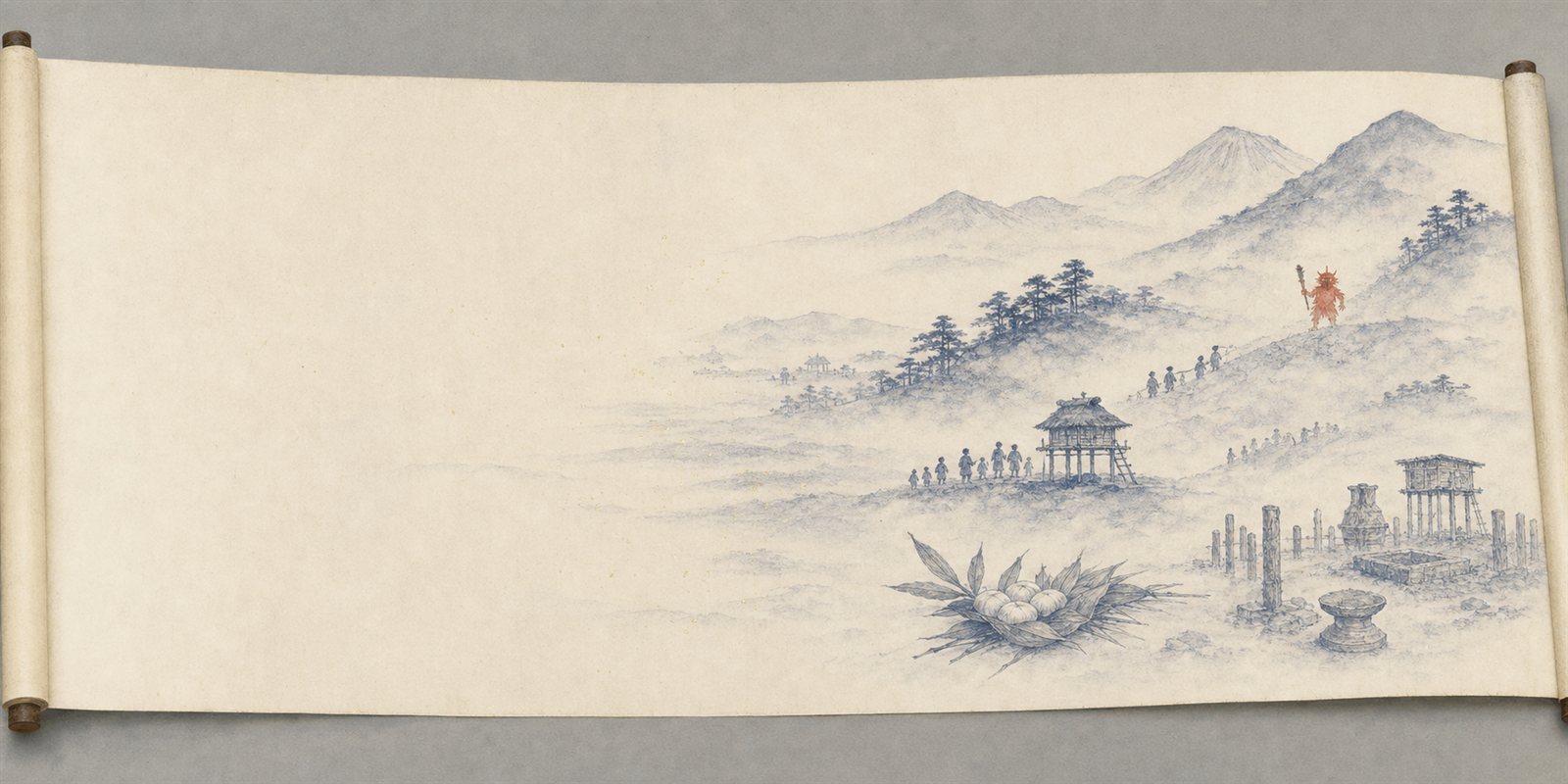 One mountain, three tales (AI-generated illustration)
I looked for the “proper record” — and there wasn’t one
When I started looking into it, I was puzzled. The ogre-slaying tale is told all over the place, yet I couldn’t find where its original, proper record actually was.
The source of the legend was an engi scroll (a record of the shrine’s origins) handed down at Sasafuku Shrine. The Iruzawa family, hereditary priests of the West Shrine, kept it for generations. But this scroll went missing around the Meiji era.
And the Hino-gun-shi (the History of Hino District), compiled in 1926, set the surviving portion into print — while adding this note:
Regrettably, the first half is lost and can no longer be seen today.
In other words, the engi we can read in writing now is only the latter half. The ogre-slaying of Mt. Kizumi — that scene of dumplings and burning bamboo — is thought to have been in the lost first half. The record is gone, yet the story remains. That was the truth behind the mystery.
Because it was lost, imagination was born
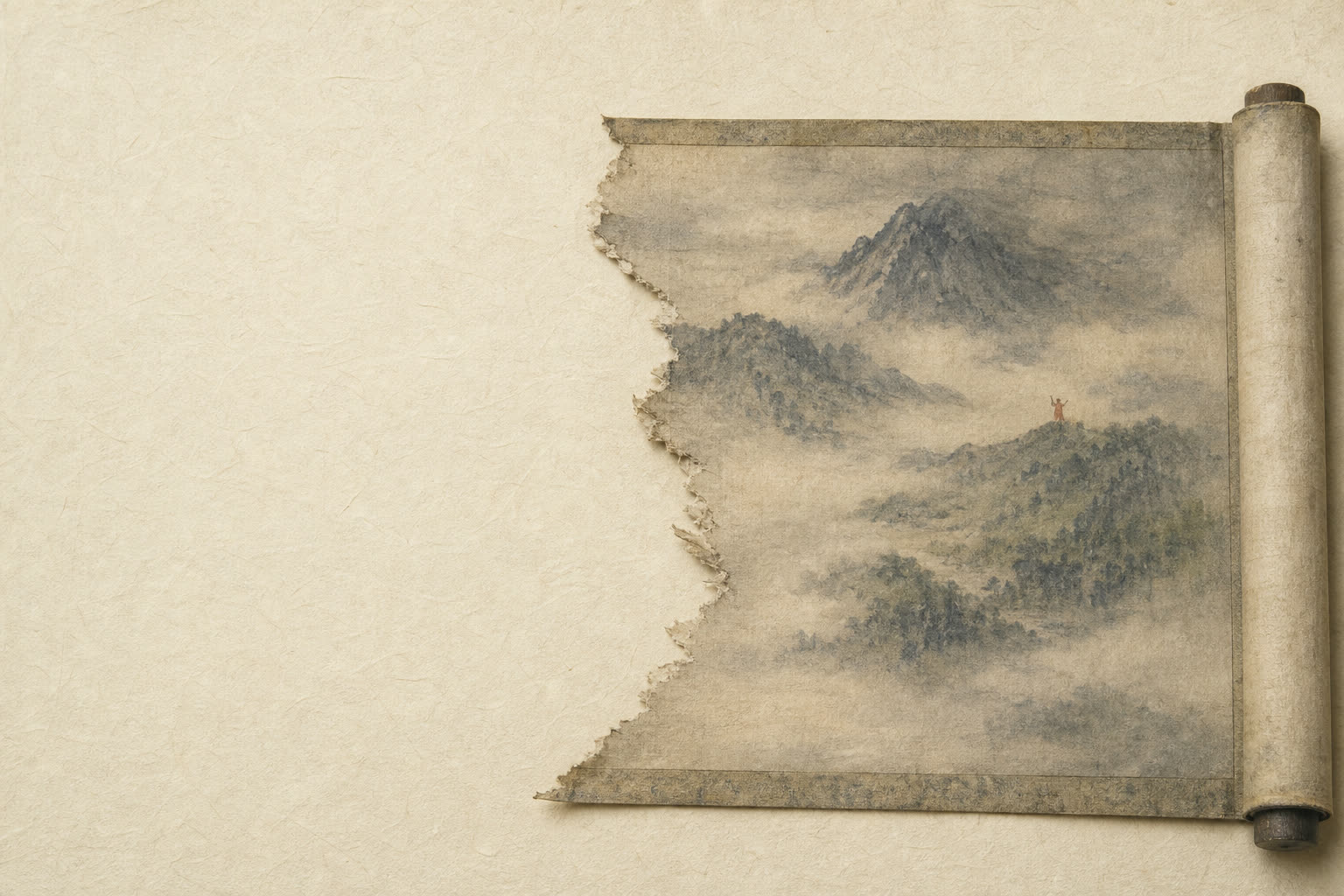 An image of the scroll with its first half lost (AI-generated illustration)
The Venus de Milo has gone on inspiring endless imaginings of “what she must have looked like” precisely because her arms are lost. The legend of Mt. Kizumi is similar. In place of the lost first half of the document, oral tradition, Edo-period gazetteers, and the shrine’s own origin records each carried this story forward in their own way.
What is truly preserved in the record, and what was filled in later by imagination? As I read on, checking that distinction — before I knew it, I had met not just the ogre’s tale but three tales. Each one was every bit as intriguing as the ogre’s.
Three tales, and their sources
The important thing is that the three come from three different sources. Let me make that clear.
- The Ogre’s Tale [Tradition] — The dumpling-and-bamboo ogre-slaying. But as I said, the engi text itself is lost and does not appear in the Hino-gun-shi either. What carried the plot were oral tradition, the Edo gazetteer Hōki Mindan-ki (which records the ogre’s mound), and the shrine’s origin lore.
- The Prince’s Tale [Record] — A quiet story of love and death in battle. This comes not from the engi but from the family chronicle of the Shin clan, an old house. Its text survives in the Hino-gun-shi.
- The Human’s Tale [Record] — An ending with no ogre in it. This is the latter half of the engi itself. It was never lost; the full text survives in the Hino-gun-shi.
I noticed something. The three do not share a single source. The ogre and the human are the first and latter halves of the same engi, but the prince comes from an entirely different family’s chronicle. Their origins are scattered.
And yet — all three end the same way.
- The ogre is not destroyed; he submits and guards the north.
- The evil ogres all yield, to the last.
- The strong man of Bitchū surrenders and becomes a retainer.
Different families, different documents, different protagonists (emperor, prince, empress). And yet the endings line up as if stamped from the same mold: “Do not destroy the enemy. Make him yield, and make him an ally.” When sources differ but the endings match, it doesn’t feel like coincidence. It is, perhaps, the shape of memory that the people of this land could not help but choose, no matter what they were telling. We’ll think slowly about what that means in the final installment.
How to read this series
So that the “certainty” of each story is clear, I mark four labels. This is to keep record and imagination from blurring together.
- [Record] — Survives in writing, in sources like the Hino-gun-shi.
- [Tradition] — Passed down by word of mouth or shrine origin lore (including, like the ogre’s tale, things whose written record was lost).
- [Theory] — A researcher’s interpretation or conjecture.
- [Speculation] — A story the writer (Toshiki) imagined.
And I list the sources at the end of every article. The Hino-gun-shi can be read by anyone for free in the National Diet Library Digital Collection. If something catches your eye, do go to the original. Checking century-old type with your own eyes is a small adventure.
A word from the rabbit: The rest of the scroll being torn off? That’s the kind of thing that keeps me up at night. But don’t worry — the people of this town have kept remembering the rest, all this time.
References:
- Hino-gun-shi, vol. 2 (Hino District Self-Government Association, 1926), ch. 14, Oral Traditions — National Diet Library Digital Collection (frames 539–543)
- Hino-gun-shi, vol. 1, Part 1, ch. 3 — ditto (frames 65–67)
- ※ This series is the writer’s retelling of the above sources in modern language. Misreadings of the old characters and old kana may be included. The originals can be checked via the links.
- ※ The illustrations are AI-generated (made as images of the story).