History

The stories of Hōki

A mountain that holds what is said to be Japan's oldest ogre-slaying legend. The Dōjigiri Yasutsuna, oldest of the Five Greatest Swords, which cut down an ogre. The sasamaki dango said to have lured an ogre out.
Famous, yet few know how these tales actually go. We walk through them one by one, with a rabbit as our guide.
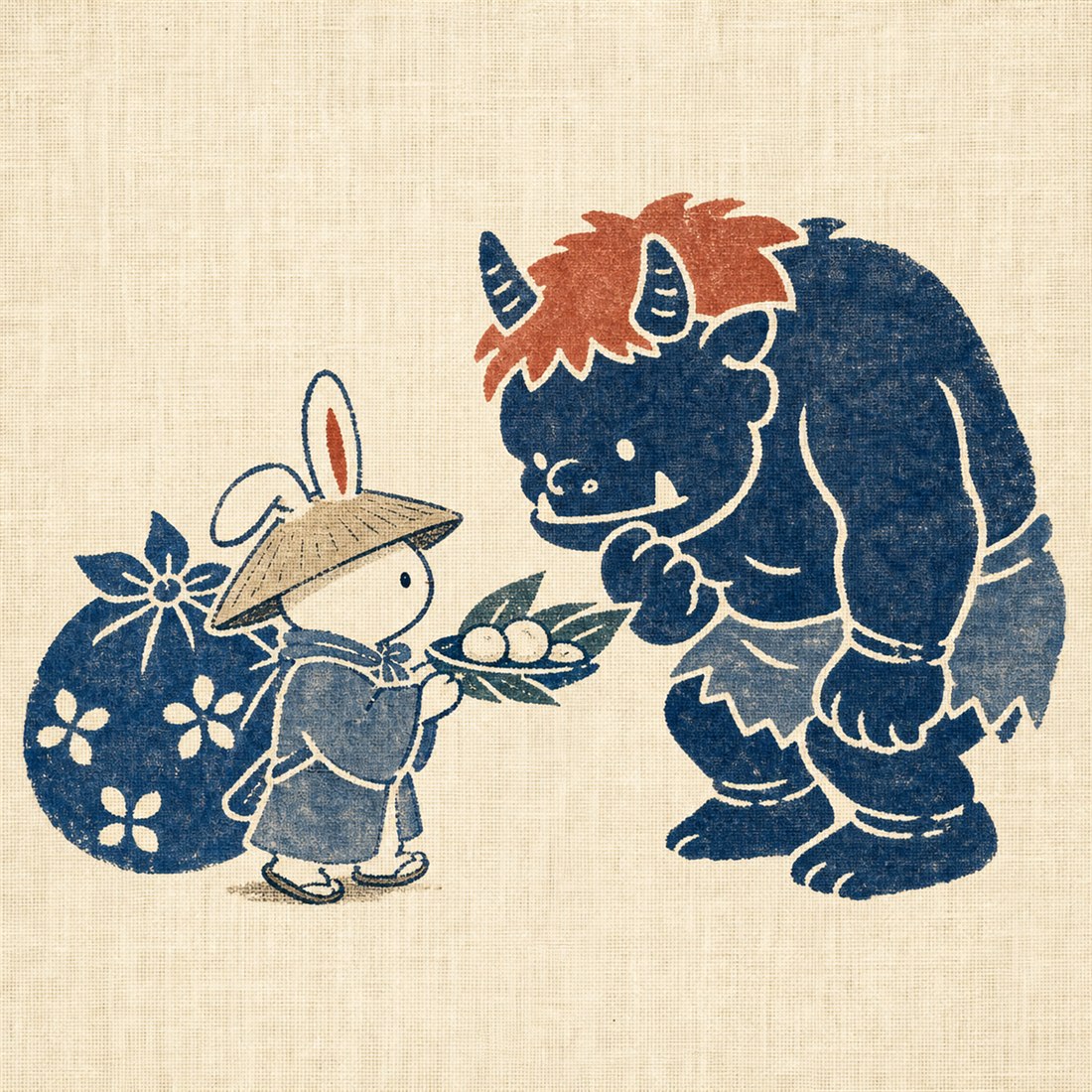
A rabbit offering sasamaki dango to an ogre, in a katazome-dyeing style
  1. 01 The Story of the Rabbit Guide A self-introduction from this site's guide, the traveling rabbit. The bond between Tottori and rabbits, and how to explore this site.
  2. 02 The Story of the Name 'Hōki' — This Town's Name Is a Country's Name If you can read 'Hōki,' you're already one of us. How a town came to carry an old provincial name, and the gateway it opens to ogres, swords, and Mt. Daisen.
  3. 03 The Legend of Mt. Kizumi — The Oldest Ogre-Slaying in Japan Emperor Kōrei and the ogre brothers Ōushikani and Otoushikani. The ogre-slaying tale handed down in Hōki Town, said to be the oldest in Japan — where the weapons were dumplings and bamboo leaves.
  4. 04 Mt. Kizumi, Three Tales (Prologue) — The Lost Scroll The town of ogres, Mizoguchi. When I went looking for the source of its legend, the crucial first half was gone. On a journey to find the record, I met three tales — each from a different source. The beginning of the series 'Mt. Kizumi, Three Tales.'
  5. 05 Mt. Kizumi, Three Tales (I) — The Ogre's Tale, and Its Ending The younger was struck down; the elder was forgiven. The dumpling-and-bamboo ogre-slaying has an ending rarely told. The real reason ogres are displayed all across this town. [Tradition]
  6. 06 Mt. Kizumi, Three Tales (II) — The Prince's Tale Another Mt. Kizumi, surviving only in one old family's chronicle. It begins with love; the ogres all yield, to the last — and still the prince did not return. [Written Record]
  7. 07 Mt. Kizumi, Three Tales (III) — The Human's Tale In the oldest surviving document, no ogre appears. The one who was there was a chieftain of the neighboring land. The tale of a man who surrendered, trembling, and an empress on her journey. [Written Record + Theory]
  8. 08 Mt. Kizumi, Three Tales (Finale) — Walking the Mountain From the tales, down to the ground. The Ogre's Mound, the Sword-Washing Pond, Onimori Bridge — the stages of the legend all really exist. And one piece of homework: which way do the town's ogre statues face?
  9. 09 Sasamaki Dango — A Flavor Carried On from Ogre-Slaying Sasamaki dango, the bamboo-leaf-wrapped dumplings said to have lured an ogre out of hiding. The story of a local flavor that has carried on from legend to today.
  10. 10 Dōjigiri Yasutsuna — The Oldest of the Five Greatest Swords, and What It Looks Like The National Treasure blade that cut down Shuten-dōji was born in Hōki. It's wildly famous, yet surprisingly few people know what it actually looks like or the legend behind it.
  11. 11 The Swordsmith Yasutsuna and Hōki's Tatara Ironmaking Why were famous swords born in Hōki? The answer lies in the iron sand of Mt. Daisen, the Hino River, and the fire of the tatara.
  12. 12 The Stone Shibi of Ōdera Haiji — one of only three stone “shachihoko” in Japan At roughly the same time the capital sat at Nara, a great temple stood at the foot of Mt. Daisen. Its stone shibi roof ornament is one of only three that survive in all of Japan. [Historical]
  13. 13 The Daisen-michi (the Mizoguchi road) and the Cattle and Horse Market — When prayer and cattle traveled the same single road Hōki Town was the gateway to Mt. Daisen. The pilgrimage road running from Mizoguchi-juku to Daisen-ji was traveled not only by worshippers, but also by the bakurō who led their cattle along it. It is even recognized as Japan Heritage. [Historical]
  14. 14 Mt. Daisen Worship — Daisen-ji and Ōgamiyama Shrine Okumiya The mountain itself was the object of faith. The history of Daisen-ji and Ōgamiyama Shrine Okumiya, and the temple-gate town that bustled with its cattle and horse market.
  15. 15 Shitori Shrine and the Izumo Cultural Sphere Shitori Shrine, the ichinomiya of Hōki Province. A story of its ties to Izumo and its faith in safe childbirth.
  16. 16 The Takomai-shiki Ritual — on the mountain farthest from the sea, an octopus dances One of Japan's three great unusual festivals. At Fukuoka Shrine, tucked among the mountains, a man clutching a giant straw octopus clings to a roof beam and is spun round and round. Why did an octopus festival take root in a place so far from the sea? [Legend + historical]
  17. 17 Nibu-juku — walking the memory of a post town on the Izumo Kaidō Between Yonago and Mizoguchi, along the Izumo Kaidō, there once stood a post town called Nibu. Information online is thin, but precisely because we live here, it's a theme we can walk out and verify on foot. [Historical · to be deepened with on-site research]