Hōki Town is home to an ogre-slaying legend that claims to be “the oldest in Japan.” It’s a story from long, long before Momotarō. The setting is Mt. Kizumi (Kizumiyama) in the former Mizoguchi area, standing 326 meters tall. The very name already tells you ogres live there.
The story in brief — where the weapons were dumplings and bamboo leaves
It was the age of the seventh emperor, Emperor Kōrei. By tradition, a pair of ogre brothers had settled on Mt. Kizumi and were terrorizing the villages. The elder was Ōushikani, the younger Otoushikani (the ogre brothers). The fact that both names contain the characters for “ox” and “crab” is hard to ignore — but let’s set that aside.
The emperor made camp on Mt. Sasuto (Sasutoyama), the mountain facing Mt. Kizumi. And rather than a frontal assault, here is how he went about it.
- He set out three sasamaki dango (bamboo-leaf-wrapped dumplings). When the younger brother, Otoushikani, came out lured by the smell, he was shot down with an arrow.
- For the elder brother who remained, he piled bamboo leaves into a mountain and let the wind carry them off. Once the leaves had clung all over the ogre’s body, he set them ablaze.
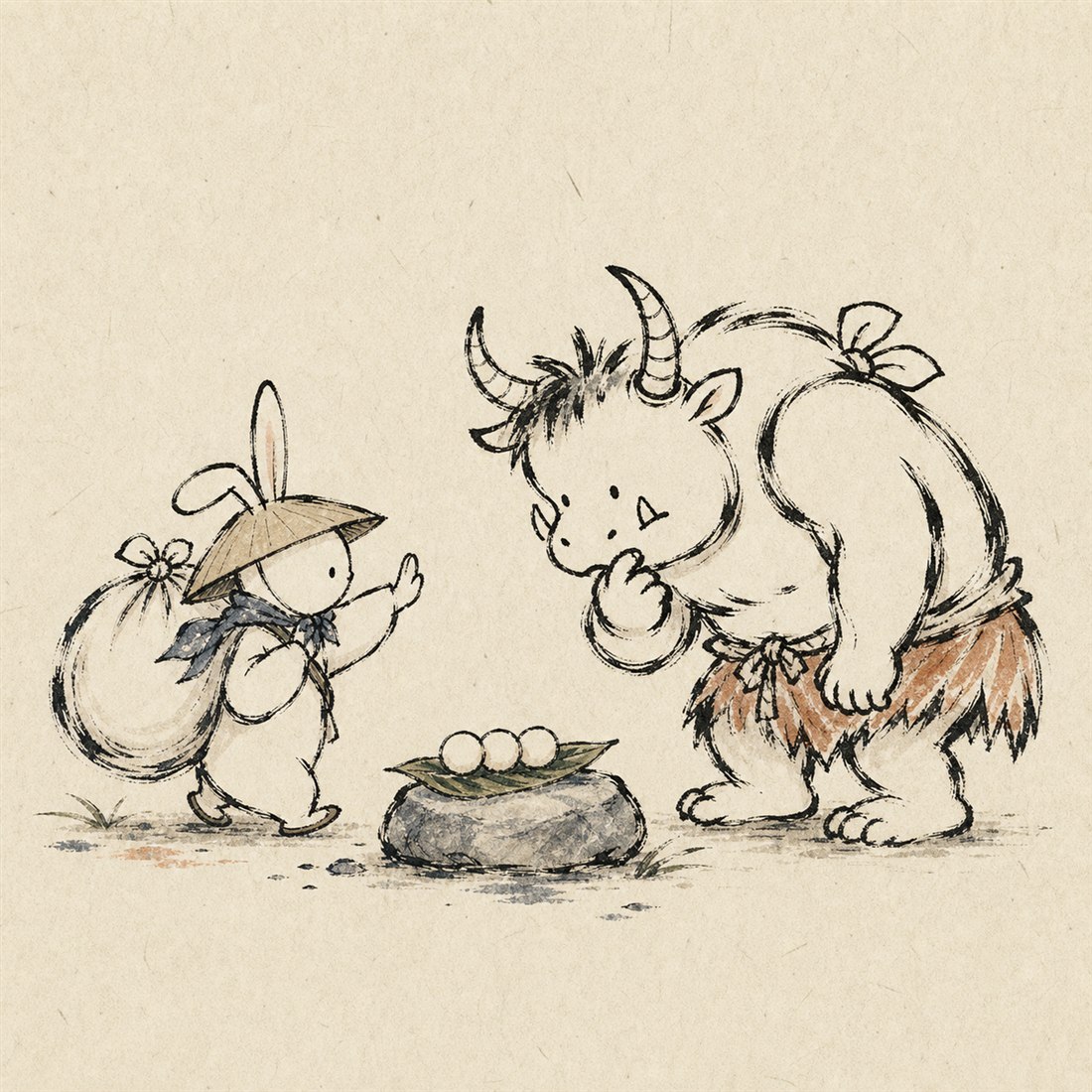
In other words, this legend is not a contest of strength but a battle of wits fought with dumplings and bamboo leaves. The reason you’ll find a rabbit offering ogres sasamaki dango all over this site comes from this very story.
Afterward, the villagers built a shrine roofed with bamboo leaves, and this is said to be the origin of Sasafuku Shrine (Sasafuku-jinja). It is a shrine dedicated to the family of Emperor Kōrei, and it still stands at the foot of the mountain today.
Walking the setting
Every place in the legend is somewhere you can actually visit.
- Mt. Kizumi — There’s a hiking course. Depending on the angle you look at it from, it’s said to resemble both the face of Okame and the mask of an ogre.
- Mt. Sasuto — The facing mountain where the emperor is said to have made camp.
- Sasafuku Shrine — The traditional site of the bamboo-leaf shrine.
You can find these places from the vermilion pins on the map.
What you can see today — slain, yet the most beloved
Here’s where it gets interesting: the town of Mizoguchi has built its town revitalization around the very ogre that was supposedly slain.
- The giant ogre statue at Onikko Land
- The bronze ogre statues lining Onimori Bridge
- Even the “ogre restrooms” near Mizoguchi Station and Mizoguchi IC
The ogre doesn’t end as a villain — it has become the face of the town. There’s even said to be a theory that this legend was the original model for Momotarō.
A word from the rabbit: An ogre that comes wandering out, lured by dumplings — you can’t quite bring yourself to hate him, can you? I can’t say no to dumplings either.
References:
- Hōki Town tourism site, “Japan’s Oldest Ogre Legend and Landscapes Where Ogres Live”
- Kyukamura Okudaisen, “The Ogre-Slaying Legend and Sasafuku Shrine”
- ※ The legendary portions of this article are at the level of shrine origin lore and folktale. The “said to be / by tradition” phrasing marks that distinction.