So far, I have written about Hōki’s swords and ogre traditions. This time, the story is a little more personal.
I read a novel
Masami Yao wrote a novel titled The Swordsmith Yasutsuna of Hōki and Dōjigiri, published by Ikuhōsha.
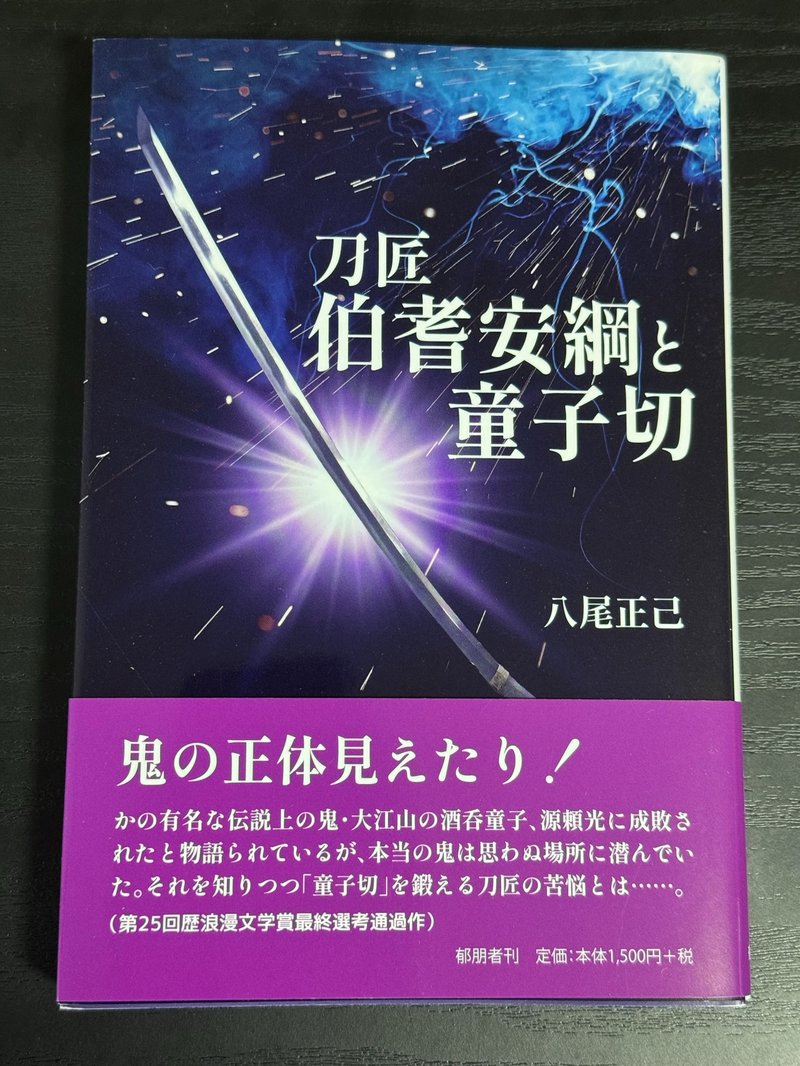
It imagines Hōki in Yasutsuna’s age, when ogres, swords, and iron crossed paths. The work reached the final selection of the 25th Historical Romance Literature Award.
It is not an effortless book. The language often carries the weight of its historical setting, and readers unfamiliar with the period may need patience. But I read it, and I found it compelling because it offered a viewpoint absent from textbooks.
Conquest stories usually centre the cutter: Minamoto no Raikō is the hero, Shuten Dōji the evil, and Yasutsuna the great smith who made a famous sword. The novel does not stop there. It imagines ordinary lives among those called ogres, and Yasutsuna as a person who spent his days facing iron and fire in the mountains. A sword could kill, but it might also be forged to protect someone.
The people in the story are best encountered in the book itself, so I will say no more about the plot.
After reading, I wanted to know
When I closed the book, questions remained. How much of Yasutsuna’s life appears in surviving records? Is the sword really about 1,030 years old? What was the Ko-Hōki school? Was there any historical relationship between Yasutsuna and the people called ogres?
So I started looking.
The records that survived
Yasutsuna’s name appears in records older than I expected.
The Kanchi-in-bon Meizukushi is one of the oldest surviving books on Japanese swords. Its original was compiled around 1316; the surviving manuscript in the National Diet Library is an Important Cultural Property. It names “Ohara Yasutsuna of Hōki Province.” It also records that General Tamura Toshihito presented a tachi by Yasutsuna to Kehi Jingū Shrine in Echizen, and transmits the claims that the blade “still did not rust” and “disliked its master”—that it chose its owner.
An even older assessment survives in a later record. In the 1240s, during the time of Hōjō Yasutoki, the Kamakura shogunate’s third regent, eleven superior smiths of old swords were selected. Yasutsuna stood first. About two centuries after his death, he was already regarded as a supreme swordsmith.
The 1483 Nōami-bon Meizukushi gives a more specific legend: a tachi by Yasutsuna, once presented to Ise Jingū, came to Raikō through a revelation in a dream, and he used it to cut down Shuten Dōji. This is the earliest currently identified written link between Yasutsuna’s sword and that ogre legend.
A sword by Yasutsuna’s son in northern Japan
Yasutsuna’s son is traditionally identified as the Ko-Hōki smith Sanemori. Several blades by Sanemori somehow survived in the Tōhoku region.
The Tsugaru family of Hirosaki Domain possessed a roughly one-metre ōdachi called Tsunamaru. In 1585, Tsugaru Tamenobu was caught in a storm while travelling toward Kyoto. He offered the sword to a dragon deity, and the storm subsided. When he returned to port, the sword was found caught in an anchor rope—tsuna—giving rise to its name. Another story says that during the 1627 lightning fire at Hirosaki Castle, the sword flew free and caught safely in a pine tree.
Swords signed Yasutsuna also travelled north. A tachi from the Date family of Sendai Domain is now in the Tome City History Museum. Other blades moved through the Mogami and Hoshina families before reaching collections in Kyoto and Tokyo.
Swords forged at the western edge of San’in crossed seas and mountains to reach northern Japan.
Many such movements can be explained through central authority: swords gathered in the hands of shoguns or the court and were then presented to regional lords. But perhaps not every journey followed that path. The novel places one act of imagination inside that “perhaps.”
Questions remain
The more I researched, the more unknowns appeared.
Five places are proposed as Yasutsuna’s forge, and no conclusion has been reached. How close is the tradition that he was a yamabushi to his real life? Why did Sanemori’s swords travel to Tōhoku? Where is Tsunamaru today? Even its present location is unknown.
Research taught me that uncertainty is not dull. The unknown is what makes the search interesting. If every answer were fixed, there would be nothing left to investigate and no space to imagine. Yao’s novel sets its story in those gaps, joining real swords, real place names, and fragments of surviving records.
If this makes you curious
A monument marks one traditional site of Yasutsuna’s forge at Ōhara in Hōki Town’s Yasugō area. Sasafuku Shrine remains open to visitors, and a return hike to the summit of Mt. Kizumiyama takes about 80 minutes.
At the Tokyo National Museum, you can see Dōjigiri Yasutsuna itself: iron from about 1,030 years ago, with its age still present beyond the glass.
If you would like to look at history from the side of those called ogres, consider Masami Yao’s novel. A Kindle edition is available and is included with Kindle Unlimited at the time of writing.
Masami Yao, The Swordsmith Yasutsuna of Hōki and Dōjigiri
Ikuhōsha / ISBN 978-4-87302-850-7
View on Amazon Japan
No one may ever know exactly what happened. Yet a surviving sword, fragments of documents, and traditions carried into the present can sometimes make a smith from ten centuries ago feel unexpectedly close.
References: Masami Yao, The Swordsmith Yasutsuna of Hōki and Dōjigiri; Kanchi-in-bon Meizukushi, original circa 1316 and surviving manuscript copied in 1423, National Diet Library, Important Cultural Property; the Yasutoki assessment reproduced in the 1314 Jōko Hidan-shō; the 1483 Nōami-bon Meizukushi; the Tsugaru-family tradition of Tsunamaru recorded in Gujikyūchōki; and the Yasutsuna tachi from the Date family now held by Tome City.
Previous: Those Who Were Called Ogres