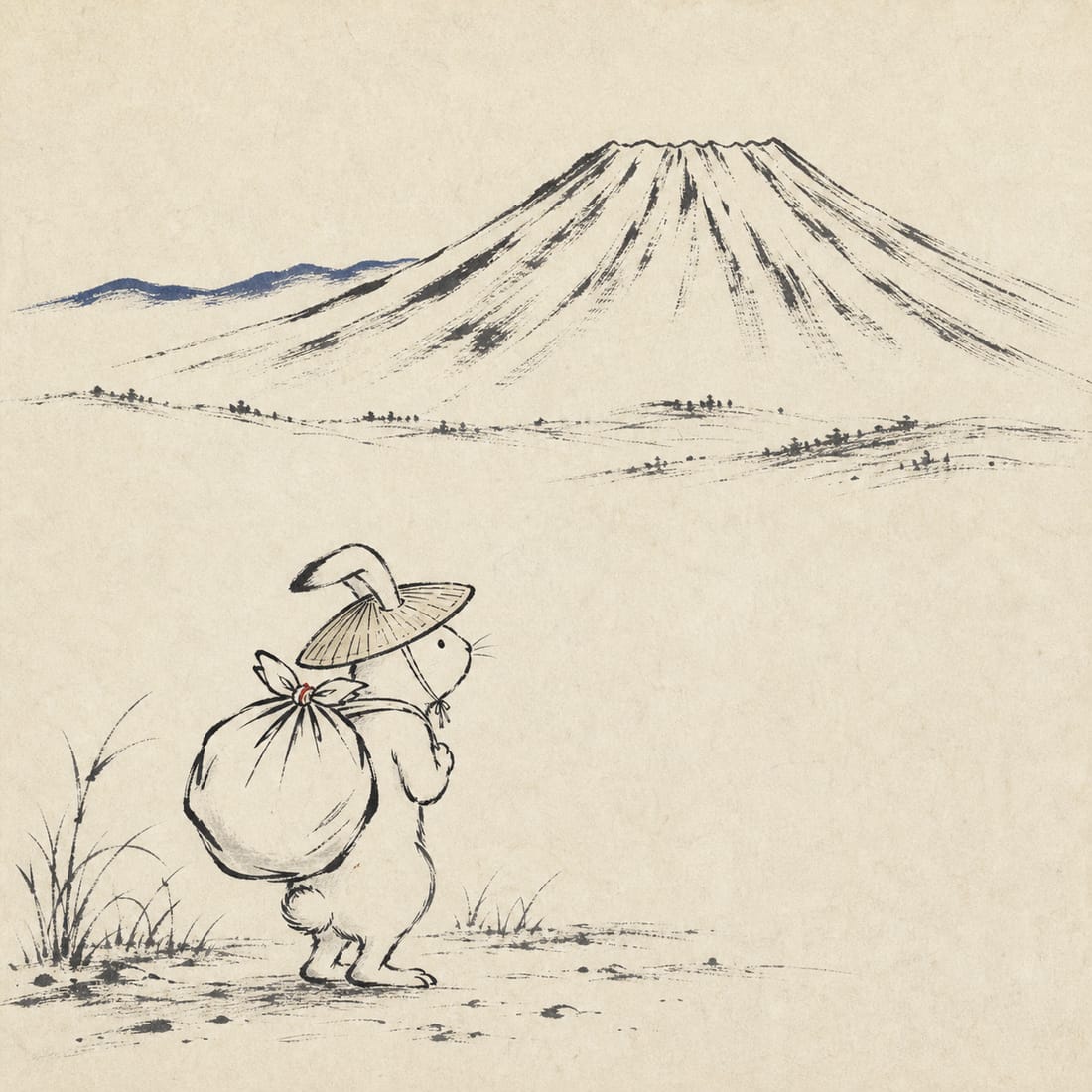
Mt. Daisen, the celebrated peak also known as “Hōki Fuji” (the Mt. Fuji of Hōki). Since ancient times, before it was a mountain to climb, it was above all a mountain to worship. A faith that revered the mountain itself as a deity nurtured the temples and shrines at its foot and the bustle of the town before its gates.
Mt. Daisen, a Mountain of Worship
With its dignified form, Mt. Daisen has been worshipped since antiquity as a mountain where deities dwell. In time it became bound up with Buddhism and flourished as a sacred site of Shugendō (the ascetic training of the yamabushi). By the medieval period it had grown into a great religious city with countless monks’ quarters, holding such power that it is said to have maintained warrior monks. Not “climbing the mountain” but “worshipping the mountain” — that was the old way of relating to Mt. Daisen.
Daisen-ji and Ōgamiyama Shrine Okumiya
At the heart of this stood Daisen-ji and Ōgamiyama Shrine Okumiya. Daisen-ji is an ancient temple of the Tendai sect, and its founding is said to date back to the Nara period. After the age of the syncretism of Shinto and Buddhism, it was divided into a temple and a shrine by the separation of Shinto and Buddhism in the Meiji era, taking its present form.
To Ōgamiyama Shrine Okumiya leads a long, stone-paved approach laid with natural stones. This approach is regarded as among the longest of its kind made from natural stone in Japan, and simply walking it brings a tightening of the spirit. At the foot of the mountain on the Yonago side stands the lower shrine (main shrine), and people moved between the two with the summer and winter.
One of Japan’s Largest Cattle and Horse Markets
The town before the gates of Mt. Daisen was not a place of faith alone. Tied to the worship of Jizō, a cattle and horse market was held before the gates, and its scale is said to have grown to be among the largest in Japan. Worshippers and the bakurō (livestock dealers) leading their cattle crossed paths on the same road — this story of “prayer and commerce” overlapping is introduced in detail in The Daisen-michi (Mizoguchi road) and the cattle and horse market.
The Approach You Can Walk Today
Even now you can walk the stone-paved approach and worship all the way to the Okumiya. In autumn, the area around Daisen-ji is wrapped in autumn foliage said to be the finest in western Japan, and the path of faith is dyed in brocade colors. Check the location on the map, and please go see it with your own feet.
Sources & references
- Spot pages: Daisen-ji and Ōgamiyama Shrine Okumiya / Ōgamiyama Shrine, main shrine (each with official links)
- *Note: Descriptions of older eras, such as the founding date, include traditional accounts. The phrase “is said to” marks that distinction.