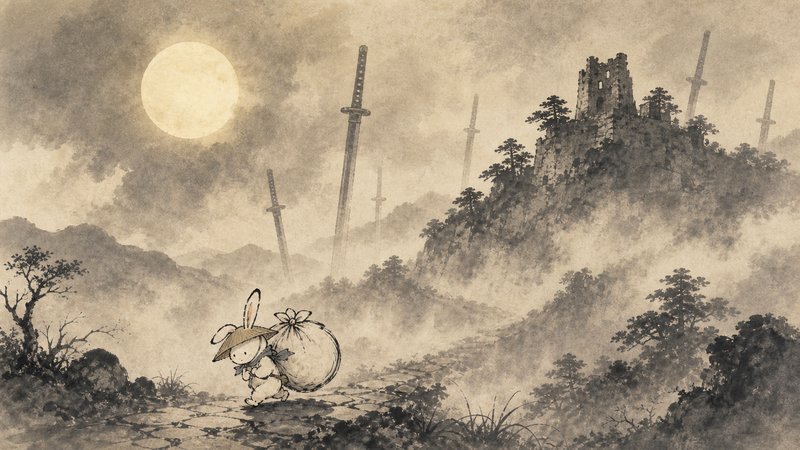
Many people love old castles: Himeji, Matsumoto, Hikone. A castle with an original surviving keep is treated as something exceptional.
There is a reason. Many castles burned in war or lightning, or were dismantled during the Meiji period. Reconstruction has its own value, but very few buildings remain exactly as they stood when first built. Temples are similar. They survived repeated fires only because people rebuilt them.
Buildings burn. Wood decays. People build again.
But what about a sword?
One tachi in the Tokyo National Museum is designated a National Treasure: Dōjigiri Yasutsuna.
It is thought to have been forged around 980–990, in the middle of the Heian period—about 1,030 years ago. It has not been rebuilt or pieced together with replacement material. Its surface has been polished many times, but the mass of iron is still the iron hammered by a smith in that age.
A human-made object 1,030 years old survives intact—and remains capable of cutting.
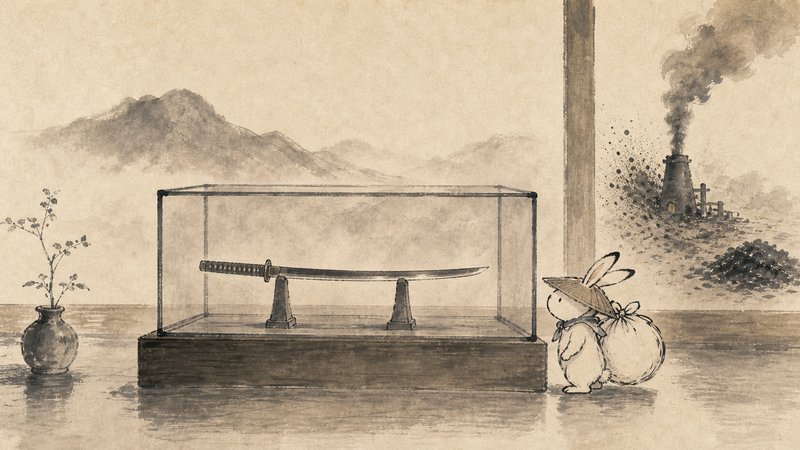
An early Edo-period record describes a cutting test in which the sword passed through six stacked bodies and bit into the earthen mound beneath them. The account is grim, but it records how an ancient tool was still considered functional centuries later.
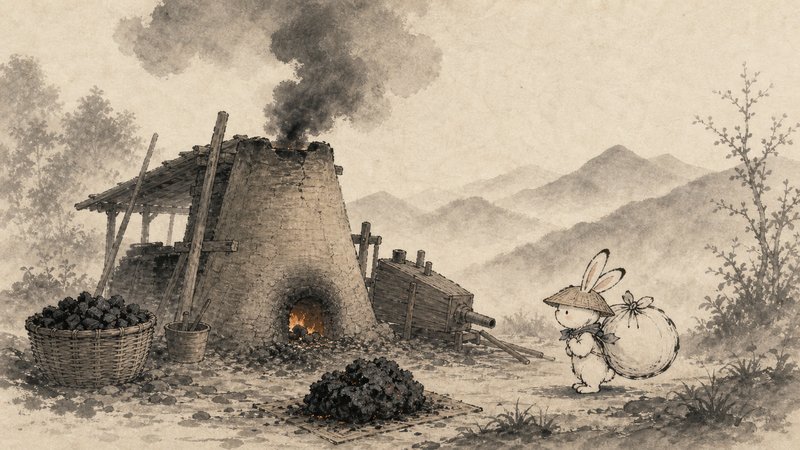
The place where its smith lived
Dōjigiri was forged by Yasutsuna, also known as Ōhara Dayū and said to have borne the family name Yokose.
He lived and worked in Hōki Province, the western part of present-day Tottori Prefecture, including today’s Hōki Town.
Together with Sanjō Munechika of Kyoto and Tomonari of Bizen, Yasutsuna is often named among Japan’s three earliest master swordsmiths. He worked at the formative stage when the Japanese sword acquired its familiar curved, single-edged shape, yet produced a blade regarded as one of that tradition’s highest achievements.
Five locations have been proposed for his forge: Ōhara in Hōki Town’s Yasugō area, Nichinan, Kurayoshi, Kusaka in Yonago, and Kamisuge in Hino. All lay within historical Hōki Province. Remains of a forge excavated at Kusaka in 1987 provide the strongest archaeological evidence so far, but the question is not settled.
First among the Five Swords Under Heaven
Five celebrated blades are known as the Tenka Goken, the “Five Swords Under Heaven.”
| Sword | Smith | Period | Collection |
|---|---|---|---|
| Dōjigiri Yasutsuna | Yasutsuna, Hōki | Mid-Heian | Tokyo National Museum, National Treasure |
| Mikazuki Munechika | Sanjō Munechika, Kyoto | Mid-Heian | Tokyo National Museum, National Treasure |
| Onimaru Kunitsuna | Awataguchi Kunitsuna, Kyoto | Kamakura | Imperial Household Agency |
| Ōdenta Mitsuyo | Miike Denta Mitsuyo, Chikugo | Late Heian | Maeda Ikutokukai, National Treasure |
| Juzumaru Tsunetsugu | Aoe Tsunetsugu, Bitchū | Kamakura | Honkōji Temple, Important Cultural Property |
Dōjigiri is commonly placed first and is the oldest of the five.
Another sword, Tenkōmaru, is preserved at Tsuboi Hachimangū Shrine in Osaka as an Important Cultural Property. The Kawachi Meisho Zue records a tradition that it and Dōjigiri were forged from the same iron—two celebrated blades born from one material.
Yasutsuna was not alone
Yasutsuna belongs to a group known as Ko-Hōki, or Old Hōki. At least twelve named smiths are associated with the tradition, including his son Sanemori and his follower Yasuie.
Yasuie also left a tachi designated a National Treasure, now in the Kyoto National Museum. Ko-Hōki therefore produced more than a single exceptional blade.
The influence extends further. Masamune, whose Sōshū tradition later came to represent a summit of Japanese swordmaking, is said to have studied the style of Ko-Hōki. One source of that later achievement lay here in Hōki.
Ko-Hōki does not fit neatly into any of the five major swordmaking traditions. Its iron is described as dark, its temper patterns free and almost wild. The blades seem to carry a force different from the refinement of the capital.
Imagining 1,030 years
Around the year 990, when Yasutsuna was working, Fujiwara no Michinaga had not yet reached the height of his power in Heian-kyō. Murasaki Shikibu had not yet written The Tale of Genji.
Iron forged in that world now rests in a museum case in Tokyo in 2026.
Names connected with the sword survive in the record: Minamoto no Raikō, Ashikaga Yoshiteru, Toyotomi Hideyoshi, Tokugawa Ieyasu. It passed between rulers, stood near battle, was feared by powerful men, nearly disappeared, and was eventually purchased by the state after the advice of a sword expert.
Through all of that, the iron remained the same.
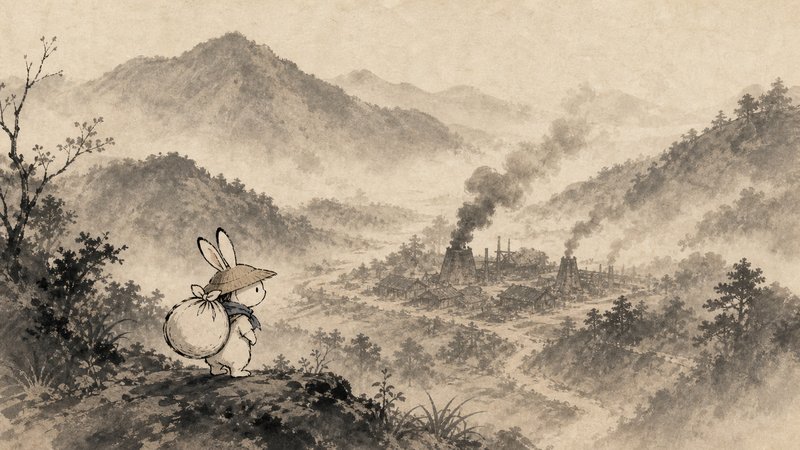
The place where that iron was born is here.
References: Dōjigiri Yasutsuna is a National Treasure in the Tokyo National Museum, designated in 1951 and purchased by the state in 1962 for ¥26.3 million. Tenkōmaru is an Important Cultural Property at Tsuboi Hachimangū in Osaka. Yasutsuna is rated Sai-jō saku by Fujishiro and 150 by Hawley. NBTHK records include 71 Ko-Hōki works at Jūyō level or above, eight of them Tokubetsu Jūyō. The five proposed forge locations are Ōhara in Hōki Town, Nichinan, Kurayoshi, Kusaka in Yonago, and Kamisuge in Hino.