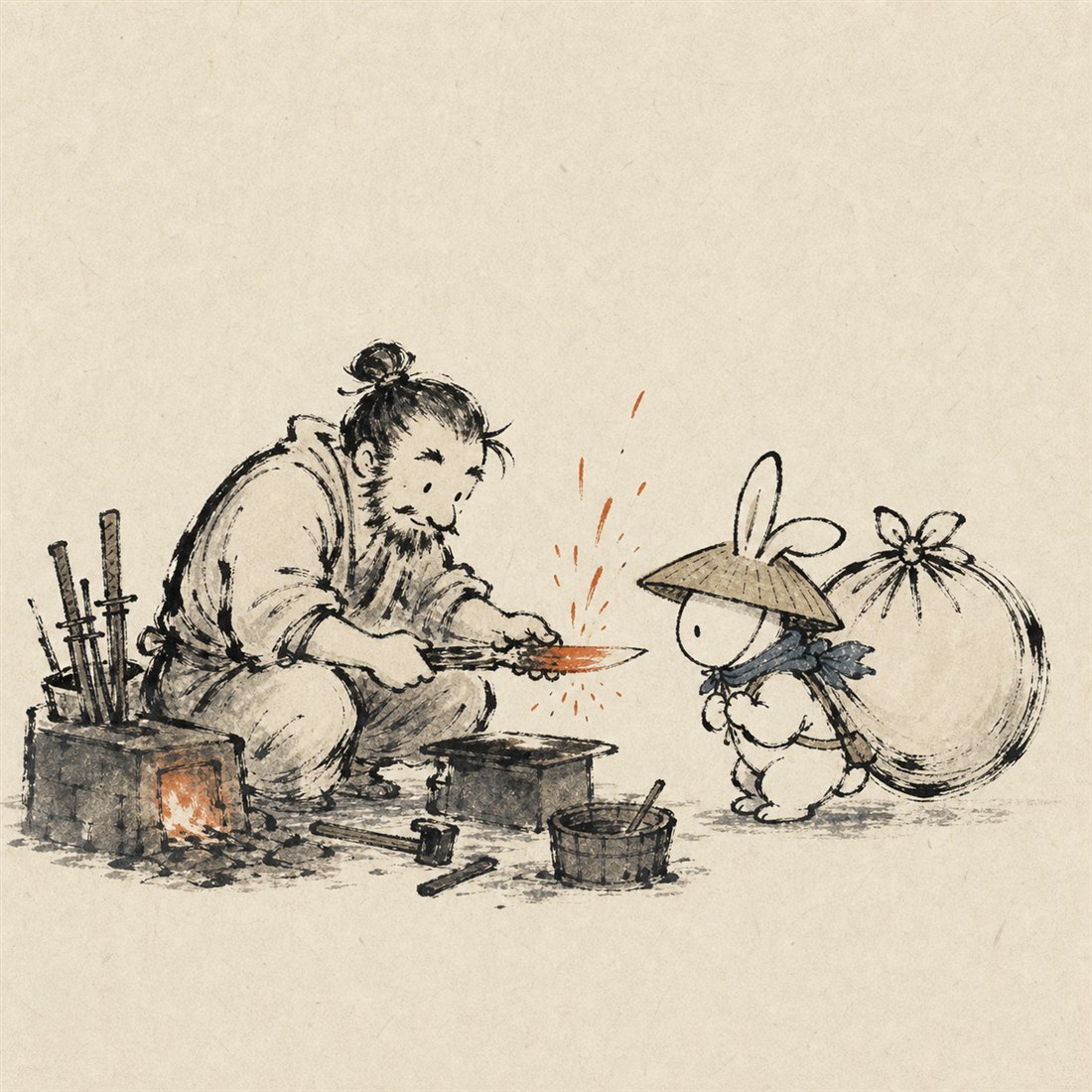
Yasutsuna, the swordsmith who forged the Dōjigiri. The Taiheiki, a war chronicle of the Nanboku-chō period, records that “in the Aimi district of Hōki Province there was an excellent smith named Ōhara Gorō-dayū Yasutsuna.” His name survives not in legend but in the written record—he was a real craftsman.
A “Founding Father” of the Japanese Sword
Yasutsuna’s work is regarded as among the very earliest of the curved Japanese sword. From the straight sword to the Japanese sword with that graceful curve—at this turning point stood a smith of Hōki. The style of Yasutsuna and his school is called “Ko-Hōki mono” (Old Hōki works), a name that always comes up when discussing the formative period of the Japanese sword.
Why Hōki?
The answer was right underfoot.
- Iron sand: The Hino River basin was a producer of fine masa iron sand. Inga steel in particular was considered the very finest.
- Charcoal: The rich forests at the foot of Mt. Daisen sustained the fire of the tatara.
- Water and roads: The Hino River carried both raw materials and finished products.
In other words, it wasn’t that “famous swords happened to be born here”—this was a land where famous swords could not help but be born. In this basin, where the fire of tatara ironmaking burned, skilled smiths grew up. That was the order of things.
Where Was Yasutsuna From?
In fact, his birthplace has never been settled. Nichinan, Hino, Yonago, and Kurayoshi each have their own traditions and archaeological finds. In Yagō-Ōhara in Hōki Town, too, there stands a stone monument marking the “Hōki Yasutsuna sword-forging tradition site”, making this one of the candidate locations as well.
The very fact that it can’t be pinned down to a single place may itself be proof that “the entire Hino River basin was a land of iron.”
A word from the rabbit: The sparks from a forge—when you see them up close, that vermilion color is so pretty. But it’s hot, so don’t try this yourself, okay?
References:
- Hōki Tatara Navi. “Yasutsuna, from the very beginning!” and “A tour of places connected to Hōki Yasutsuna”
- Waraku web “What is Ko-Hōki?”
- *There are various theories about his birthplace; this article does not make a definitive claim.