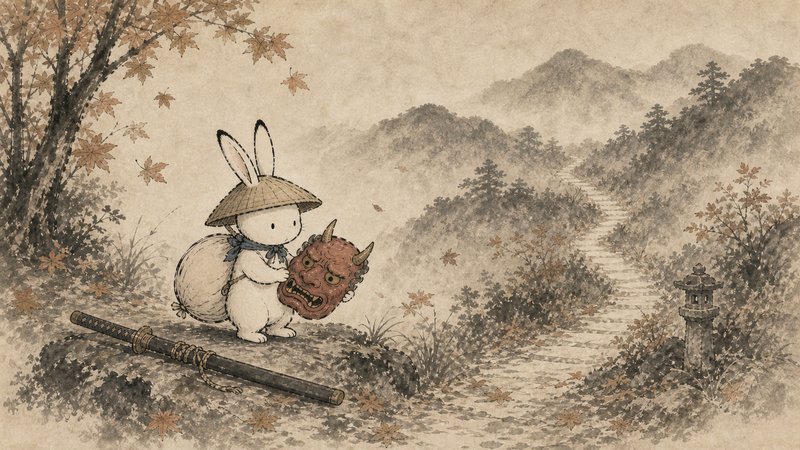
Walk around the Mizokuchi area of Hōki Town and you will find ogres everywhere.
JR Hōki-Mizoguchi Station is shaped like one. An ogre telephone box stands outside. Small bronze ogres line bridge railings, and farther into the hills rises an 18-metre bronze figure of Ōushigani.
Ogre traditions have deep roots here. But what was an “ogre”?
The oldest ogre story
Hōki’s oldest ogre tale is the conquest associated with Emperor Kōrei, the seventh emperor named in the Kojiki and Nihon Shoki. In local tradition, he defeated ogres at Mt. Kizumiyama, a 326-metre mountain in Hōki Town.
Whether Emperor Kōrei was historical is unresolved. The reign dates given in the early chronicles extend into the centuries BCE and are generally regarded as artificial. Proposed historical settings range from the late Yayoi into the Kofun period.
Sasafuku Shrine in Miyabara, however, says that Emperor Kōrei and his consort were enshrined there as Sasafuku Ōkami in 709. Whatever the origin of the story, people here have venerated an ogre-defeating emperor for at least thirteen centuries. As a narrative, it belongs among Japan’s oldest ogre traditions.
Who were the ogres?
Were they really horned monsters?
In old Japanese stories, beings described as ogres often represent people who did not submit to central authority: mountain communities with their own customs, outside the control of the capital. The writers on the side of political power labelled such people oni.
Hōki’s legend can be read in that way. The area was rich in iron sand and supported ironworking from an early date. Extracting iron sand meant cutting into mountains and washing earth into rivers, which could cause flooding downstream. One interpretation holds that these disasters were remembered as the work of ogres, while controlling them became an “ogre conquest.”
Ogres and iron are intertwined in Hōki from the beginning.
Another ogre: Shuten Dōji
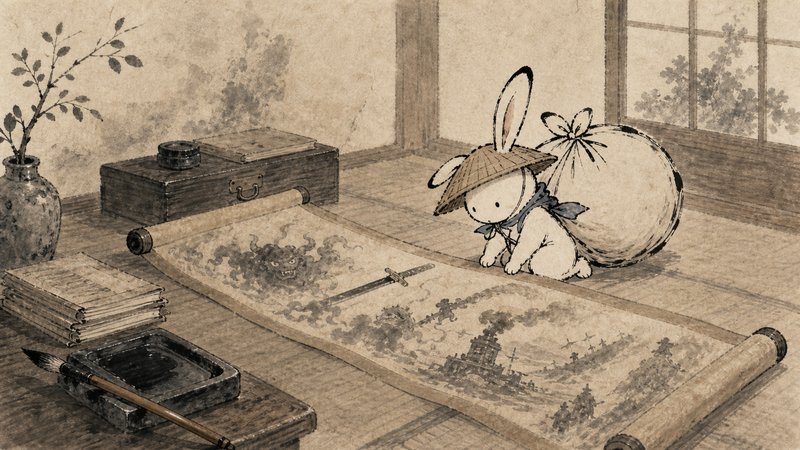
Many centuries later comes Shuten Dōji, one of Japan’s most famous ogres. Legend places him on Mt. Ōe, threatening the capital, until Minamoto no Raikō and his Four Guardians killed him. Noh drama and illustrated scrolls carried the tale widely.
The conquest is variously dated to 990, 995, or 1018. Raikō was a historical person, but the battle with Shuten Dōji is legend.
One physical object nevertheless crosses into the story: the sword said to have killed him was a tachi by Yasutsuna. The name Dōjigiri—“Dōji Cutter”—comes from this tradition. Legend and surviving artefact meet on the blade.
Where did Shuten Dōji come from?
Several traditions describe his origin. One places him in Echigo Province, present-day Niigata. Driven from his birthplace, he wandered from place to place before reaching Mt. Ōe. Before stories called him an ogre, he had belonged somewhere.
That raises the same question found in Hōki’s older tale. Although the settings differ, both follow a similar structure: central power calls an outsider an ogre and turns that outsider’s defeat into a heroic story.
Almost no voice from the defeated side survives. Records are usually made by the victors.
On which side was the swordsmith?
Yasutsuna was traditionally said to have been a yamabushi, a mountain ascetic. He was not a man of the capital, but someone who lived near the mountains, worked iron, faced fire, and forged swords.
The Taiheiki, compiled around the 1370s, calls him a skilled smith named Ōhara Gorōdayū Yasutsuna of Aimi District in Hōki Province. The Kanchi-in-bon Meizukushi, whose original dates to around 1316, records “Ohara Yasutsuna of Hōki Province” and transmits claims that his tachi did not rust and “chose” their owners.
The name and swords survive, but almost nothing is known of his daily life or inner world. What we do know places him close to mountains, iron sand, furnaces, and other ironworkers.
The people called ogres were also imagined as mountain dwellers connected with iron.
Yasutsuna is remembered as the man who made an ogre-killing sword. Yet he himself lived far from the capital, much closer to the world of those labelled ogres.
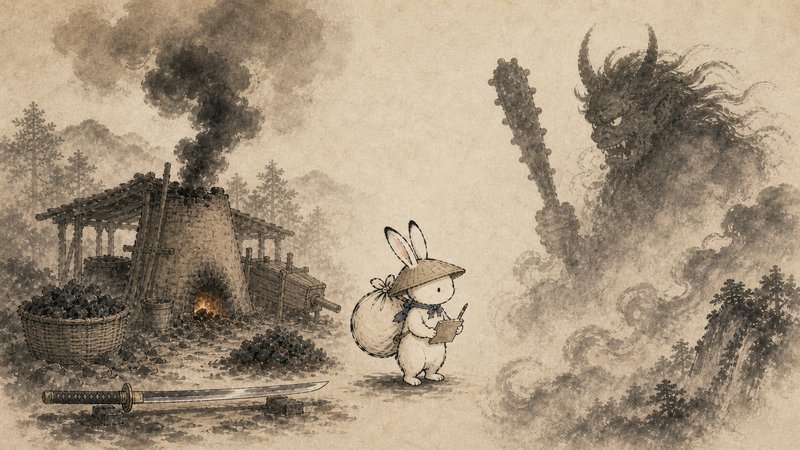
Between the cutter and the cut
Ogre-conquest stories make the killer the hero. Raikō is celebrated, while Shuten Dōji is cast as an evil that must be destroyed.
Where, then, did Yasutsuna stand? Perhaps he belonged fully to neither side.
In Hōki, ogres, iron, and swords cross within the same history: a thirteen-century-old memory of an ogre conquest, a sword forged about 1,030 years ago, and a name that says the sword cut an ogre.
We do not know exactly what happened. Legends remain legends and the written record is fragmentary. But surviving objects, documents, and local stories can reveal landscapes hidden behind textbook dates.
What did the people called ogres do in this land? What did Yasutsuna think as he forged his blade?
References: Emperor Kōrei is the seventh emperor named in the early chronicles and a deity of the Sasafuku shrines in Miyabara and elsewhere in Hino District. Traditions place Shuten Dōji’s origin in Echigo, Mt. Ibuki in Ōmi, and other regions; his defeat is variously dated to 990, 995, or 1018. Yasutsuna is traditionally described as a yamabushi. The Kanchi-in-bon Meizukushi is among the oldest surviving sword books; its original is dated around 1316 and the National Diet Library copy is an Important Cultural Property.