Dōjigiri Yasutsuna is a National Treasure forged in Hōki and traditionally said to have killed the ogre Shuten Dōji. Its name is famous, but there is one curious detail.
The sword was not called Dōjigiri from the beginning.
Reading old records in chronological order reveals a name that developed gradually. This article traces when and how “Dōjigiri” emerged, going back wherever possible to the earliest surviving texts.
The short answer
The claim that this was the sword that killed Shuten Dōji appears to have been added later, during the Muromachi period. Earlier records give the blade other names and other histories. The Shuten Dōji conquest story itself is also thought to have taken shape in the Muromachi period, as the Tokyo National Museum explains.
Here is the sequence.
1. Around 1423 — the sword was called Sohaya
One of the oldest surviving books on Japanese swords is the Kanchi-in-bon Meizukushi. Yasutsuna appears in it in a passage that may be rendered as follows:
“Yasutsuna made General Tamura’s sword Sohaya, and was a master craftsman.”
Yasutsuna is introduced as the distinguished smith who made the sword Sohaya for Sakanoue no Tamuramaro, also known as General Tamura. At this stage, neither Shuten Dōji nor the name Dōjigiri appears.
2. The Nanboku-chō-period Taiheiki — Onikiri appears, but not Shuten Dōji
Volume 32 of the war chronicle Taiheiki includes a section known as “Onimaru and Onikiri.” It explicitly names Yasutsuna:
“This sword was forged with a pure and devoted heart by the smith Ōhara Gorōdayū Yasutsuna of Aimi District in Hōki Province.”
The sword forged by Yasutsuna is called Onikiri, or “Ogre Cutter.” It is not yet described as the sword that killed Shuten Dōji. The ogre in this account belongs to a different story, involving the warrior Watanabe no Tsuna.
3. 1483 — the sword becomes connected with Shuten Dōji
In the Muromachi-period Nōami-bon Meizukushi, a new statement appears:
“Raikō received it through a revelation in a dream, and with this sword cut down the ogre called Shuten Dōji.”
This is where Yasutsuna’s sword finally becomes the blade that killed Shuten Dōji. An older history attached to a sword by Yasutsuna seems to have merged with the Shuten Dōji story, which was popular at the time.
4. 1719 — established as the celebrated sword Dōjigiri
The Kyōhō Meibutsuchō, an Edo-period register of celebrated swords compiled on the orders of the eighth shogun, Tokugawa Yoshimune, records the following tradition:
“It is said that Lord Raikō used this sword to defeat a mountain bandit of supernatural powers who lived on Mt. Ōe in Tanba Province.”
The identity “the sword that killed Shuten Dōji”—and therefore the name Dōjigiri, “Dōji Cutter”—became firmly established as part of the blade’s celebrated history.
A caution: there are two swords called Onikiri
This is an easy point to confuse. Two separate swords have been called Onikiri.
- A. Dōjigiri Yasutsuna, the sword discussed here, which was also associated with the names Onikiri and Sohaya in older records.
- B. Onikirimaru, also called Higekiri, at Kitano Tenmangū Shrine, a different blade handed down within the Minamoto tradition.
The second sword was once attributed to Yasutsuna. More recent research by the Kyoto National Museum, however, identifies it as a Kamakura-period work rather than a blade by Yasutsuna. The shared name does not make them the same sword.
What does “Sohaya” mean?
The oldest name is also the hardest to explain. There is no single confirmed answer.
Old sources write the sound sohaya with several different sets of characters. It has also been connected with the legendary sword Sōhaya associated with Sakanoue no Tamuramaro and preserved at Kiyomizudera Temple in Hyōgo. The sound seems to have come first, with different characters assigned to it later.
It is tempting to imagine that the character for “arrow” referred to the curve of a bow, but no early record supporting that idea was found. The honest conclusion is that the origin remains uncertain and several theories coexist.
Summary — a name grows with its stories
The sequence can be arranged like this:
- Sohaya — General Tamura’s sword, recorded around 1423
- Onikiri — named in the Taiheiki, but not yet linked to Shuten Dōji
- The sword that killed Shuten Dōji — the connection appears in the 1483 Nōami-bon Meizukushi
- Dōjigiri — established as a celebrated sword in the 1719 Kyōhō Meibutsuchō
Over several centuries, one sword’s name developed alongside the stories told about it. Seen that way, the name Dōjigiri carries more history than a single dramatic episode. The sword itself survives today as a National Treasure in the Tokyo National Museum.
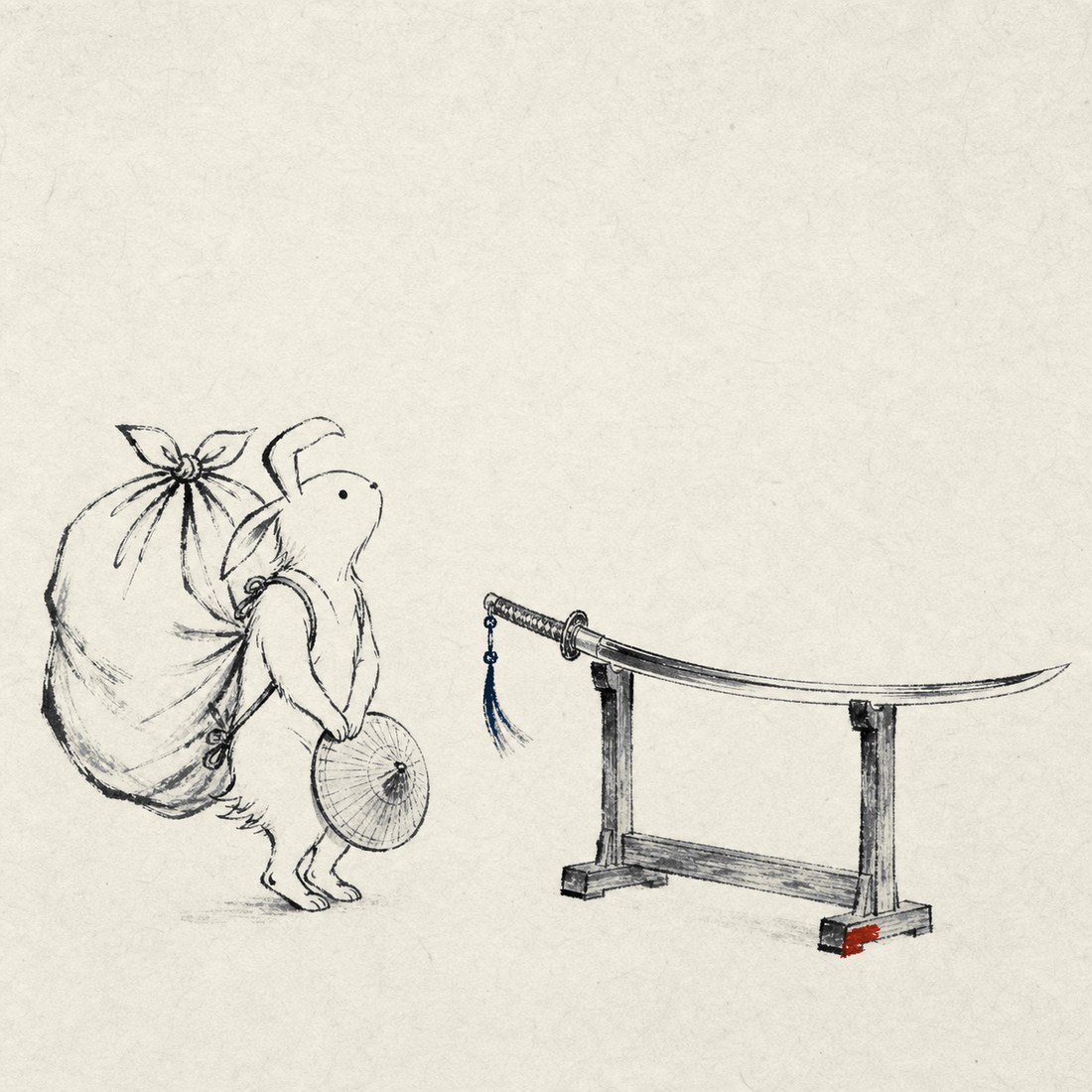
A note from the travelling rabbit: I always thought names were there from the beginning. It turns out even a sword can have a childhood name.
History and legend
- Historical record: Yasutsuna was a real smith associated with Hōki and is named in the Taiheiki and Kanchi-in-bon Meizukushi. Dōjigiri survives and is a National Treasure in the Tokyo National Museum.
- Legend: Minamoto no Raikō killed Shuten Dōji with this sword. The story took shape in the Muromachi period and was later attached to the blade’s history.
- The origin of the name Sohaya remains disputed; this article does not present one theory as certain.
Sources and early texts:
- Kanchi-in-bon Meizukushi, National Diet Library Digital Collections: https://dl.ndl.go.jp/info:ndljp/pid/2586654
- Taiheiki, volume 32, full Japanese text at Wikisource: https://ja.wikisource.org/wiki/太平記/巻第三十二
- Shōchū Tōken Meibutsuchō by Ukō Inshi, a transcription related to the Kyōhō Meibutsuchō, National Diet Library: https://ndlsearch.ndl.go.jp/books/R100000002-I000000566839
- “Tachi, signed Yasutsuna (Dōjigiri Yasutsuna),” e-Museum / Tokyo National Museum: https://emuseum.nich.go.jp/detail?langId=en&content_base_id=100186
- The quoted wording from the Nōami-bon Meizukushi is reproduced in later reference works including Fukunaga Suiken’s encyclopedia of Japanese swords.